Wednesday, February 6, 2013

Nix Minus One


Fifteen-year-old Nix Humbolt doesn't talk much. He's barely outgrown his "Fatty Humbolt" days, and although he is taller and leaner now, he has learned it is best to keep a low profile. He dreams about his only friend's girl, but of course she is hopelessly out of his league.

Lonely and introverted, he is happiest in his father's woodworking shop, where he builds exquisite boxes and tables. The only battles Nix fights are on his Xbox - until the day he finds the guts to fight for Swiff Dunphy's neglected dog. Then there is Roxy, Nix's spirited older sister who always knows just how to get what she wants. But the guy she wants is seriously toxic, and even Nix can see that she is headed for disaster. All Nix can do is cover for her when she breaks curfew or comes home drunk. But this time Roxy is about to spiral out of control and change all their lives forever. And there is nothing he can do to stop it.

Another powerful novel by the author of The Nine Lives of Travis Keating, Home Truths and The Present Tense of Prinny Murphy.   Jill Maclean’s new novel is written in verse, and like her other novels, deals with some heavy issues.  I couldn’t put this book down, and I read it in one night.  Nix, the main character, was an easy person to relate to.  I found myself frustrated with him, and at the same time I could totally understand his worry, and his reluctance in challenging his older sister.   It’s common for siblings to cover for each other, when one of them is breaking the rules.  But that doesn’t mean the other person doesn’t worry.  And as long as no one gets hurt, these secrets can remain a secret.  But unfortunately, that’s not what happens for Nix and his sister. 

Nix is a bit insecure, and turns to woodworking when he feels anxious.  It’s this wonderful talent, that makes other people understand him better.  His only friend is Chase, the school star hockey player.  Nix has a secret crush on Chase’s girlfriend, but of course it’s an impossible situation.  And then Chase’s sister enters the picture.  I liked her character a lot because I think she understood him best.  She gave him the space he needed, and she was gracious.  A true friend.

I really liked how Nix saves the dog, and how that helps him find his voice.  In the end, it saves him too. 
I loved the point of view.  I loved the characters.  I loved this book.

order from Tinlids today


Monday, January 7, 2013

What Happened to Ivy


Fifteen-year old David sometimes feels invisible to his parents. His sister Ivy has multiple disabilities, and no matter what’s happening in David’s life, Ivy’s needs come first.   Even though Ivy is eleven years old, she needs constant supervision, wears diapers, and often embarrasses David in public.  Sometimes she scares off his friends too, but no matter what, David loves his sister.  She’s always thrilled to see him, yelling his name “Ga-beg” and giving him slobbery kisses.  
When a new girl, Hannah, moves in across the street, David starts to have feelings for her.  And when Hannah meets his family, those feelings become even stronger.  David has finally met someone who understands him, and more importantly, she isn’t uncomfortable being around Ivy.

Everything changes when they go to the cottage, and Ivy has an accident while her father is looking after her.  Suddenly, David is questioning his father’s role and wondering what really happened to Ivy.  Could he really be responsible for the accident? 

For such a little book, this novel really tackles a big topic, and I admire how sensitive and honest Kathy Stinson‘s writing is.   Although I have never lived with mentally challenged children or adults, I have worked with some, in group home settings.  Reading this book brought back many memories of those children, and I feel the author created very authentic characters.  I appreciated David’s honesty in explaining how frustrating it was to live with Ivy at times.  Sometimes he just wanted his parents to himself.  And he often felt they only saw him as a helper for Ivy. 

Many people don’t understand disabilities unless they live with them.   This story really gives you an idea about the complicated feelings a person can have.   The author expressed this very well, especially through David: “Or was Ivy’s life tougher than I ever let myself believe?  How do you weigh crappy stuff like seizures and physio and people hardly ever understanding you, up against giggles and grins and just being happy with birds and pretty flowers and your sunhat and your turquoise bathing suit? How can anyone know whether someone else's life is worth living or not, especially if that someone can’t tell you about it?”

After the accident, David’s family is turned upside-down.  David’s anger towards his father is compounded by the fact that Hannah doesn’t believe David, when he tells her what really happened.  Hannah has her own issues, and doesn’t want to see David’s father in a negative light.  The ending is perfect.  It’s just real life.  No tidy resolution, and lots to keep thinking about. 

I loved this book!

Tuesday, November 6, 2012

My Book of Life by Angel

This is a gripping story about a teenage sex worker trying to survive on the streets, during the Picton murders.
 

It starts when Call sees sixteen-year-old Angel stealing shoes at the mall. He just buys her Chinese food at first, but before long Call is supplying her with "candy" and saying he loves her. Angel ends up living with him and walking the Kiddy Stroll in Vancouver's Downtown Eastside -- a neighbourhood with a reputation for being the poorest postal code in the country, with one of the highest rates of HIV infection in the world. 

When Angel’s best friend Serena goes missing, Angel starts to pay attention to the stories of other girls who have disappeared, and a mysterious Mr. P. who drives a van with tinted windows.  The girls who get in the van never come back.  They don’t go missing. They’re dead.  

Then Call brings home another girl. Her name is Melli, and she is just eleven years old, and suddenly Angel realizes what she must do. Save Melli at any cost, and perhaps save herself at the same time.

How Angel ends up on the street is very believable, and probably more common than we want to admit.  Her mother dies of cancer, and her father isn’t coping well. He doesn’t know what to do with Angel. Angel starts staying away from home – mostly hanging out at the mall.  And then she starts shoplifting.  She wants to be home, but after meeting Call, and getting caught with drugs, her father kicks her out.  He doesn’t want her around her younger brother.  And so begins her life of prostitution and drugs.  Every time she tries to leave, Call threatens to harm Angel’s younger brother. But Call underestimates Angel.   He doesn’t count on her caring about Melli. And he doesn’t count on her inner strength.  

I was drawn to this book, because I think Martine Leavitt is a brilliant author (I loved Tom Finder and Heck Superhero), and also because she based her novel on the true stories of the women who disappeared and were later found murdered, on the Picton farm. I imagine it’s difficult to research and write such a story, but Leavitt told it with such sensitivity and respect for the characters, and without smoothing things over.  

Her use of narrative verse quickly brings the reader right into the heart of the story, and that’s where you stay.  It was hard to put down and I ended up reading it in one sitting.  Like other great books written in verse, when it’s done as well as this, every line counts.  

I think this book will have adult crossover appeal.  It’s a grim story, but one that is important to tell, and Martine Leavitt has told it beautifully.  


Friday, October 26, 2012

Graphic Novels for Middle School

Thanks to my guest blogger Fatma Faraj for these two reviews.  Fatma is a teacher librarian at Royal Orchard Middle School in Brampton Ontario.  
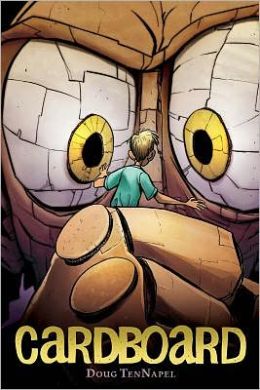

CARDBOARD
by Doug TenNapel (9780545418737) Review by: Fatma Faraj


Summary:  Cam’s down-and-out father gives him a cardboard box for his birthday and he knows it’s the worst present ever.  To make the best of a bad situation, they bend the cardboard into a man- and to their astonishment, it comes magically to life.  But the neighbourhood jerk, Marcus, warps the powerful cardboard into his own evil creations that threaten to destroy them all. 

Review: When opening a new graphic novel from Doug TenNapel, the reader knows they will be entering a weird and wondrous world.  And Mr. TenNapel does not disappoint.  Cam’s father is out of work and when on a job search, meets a salesman who sells him a piece of cardboard.  Now, that’s simply stating the facts.  The salesman is no ordinary salesman, and the cardboard is no ordinary piece of cardboard.  Just like the father in the movie Gremlins who buys Gizmo for his son as a gift, the cardboard comes with some rules:

#1- Return every scrap you do not use.
#2- You can’t ask for any more cardboard

The story has many themes running through it, such as: father-son relationships, bullying, loss of a parent, friendships, and power.  Depending on how the reader reads the text, there are many positive and negative examples of each to inspire conversation and question the choices the characters (and the author) make throughout the story. 

The book has no age ratings; however, I would put this in junior and intermediate libraries.  There are moments of violence- one of the cardboard characters is a boxer- and weapons are created to fight the “bad” characters.   And there are moments that are scary as creatures come to life and fight to gain power.  If you are familiar with Ghostopolis and Bad Island, and have them in your library collection, CARDBOARD would fit right in, almost like a trilogy.

CARDBOARD is a fun read, with characters that are three-dimensional and believable.  There are moments when the reader is genuinely scared for Cam and his adventure; however, there is also a strong feeling that everything will all be okay.  It is a story that allows characters to learn from their flaws.  One might even compare this story to Pinocchio, where one wishes to be a real and better person one day.   


DRAMA by Raina Telgemeier (9780545326995) Review by: Fatma Faraj

Summary:  Callie loves theatre.  And while she would totally try out for her middle school’s production of Moon over Mississippi, she can’t really sing.  Instead she’s the set designer for the drama department’s stage crew, and this year she’s determined to create a set worthy of Broadway on a middle-school budget.  But how can she, when she doesn’t know much about carpentry, ticket sales are down, and the crew members are having trouble working together?  Not to mention the onstage AND offstage drama that occurs once the actors are chosen.  And when two cute brothers enter the picture, things get even crazier!     

Review: Raina Telgemeier’s graphic novel SMILE is one of the most popular books in my middle school library.  When I saw her new book was being published, I couldn’t wait to read it myself.  Is it as good as SMILE?  I don’t think so.  Did I like it?  Absolutely.  I was the student who loved the theatre and couldn’t sing so I joined the stage crew myself when I was a young student.  And Telgememeier gets it right when the drama backstage is just as exciting as the drama onstage.
 
DRAMA tells the story in the style of a musical production, instead of chapters, there are acts.  The characters in the story are typical middle school students with angst, talent, and romance.  Callie, the main character, works with her best friend behind the scenes, crushes on boys, and experiences many emotions throughout the story. 

One of the most poignant moments is when Callie is talking to a boy and he tells her he’s gay.  It is very natural and true to the moment.  There are true moments of what a middle school student may go through in their two to three years at that age level, and this book captures many of those events in funny and endearing ways. 

This book will be popular with middle school students (grades 6-8).  Can it be put in a junior school? I think so; however, I think that older students will appreciate and understand the themes in this book more so than younger students.  The themes can be considered mature considering there are themes of romance and relationships that may be new to some readers.

DRAMA is a fun read for students, especially the girls who are looking for graphic novels to read.  After reading, they will feel as if they have been to the theatre- seeing the antics that occur onstage and backstage at the show. 

Bravo to DRAMA!
 

Sunday, September 30, 2012

Every Day

Every day a different body. Every day a different life. Every day in love with the same girl. 

There’s never any warning about where it will be or who it will be. A has made peace with that, even established guidelines by which to live: Never get too attached. Avoid being noticed. Do not interfere.

It’s all fine until the morning that A wakes up in the body of Justin and meets Justin’s girlfriend, Rhiannon. From that moment, the rules by which A has been living no longer apply. Because finally A has found someone he wants to be with—day in, day out, day after day.

Every day, A has to figure out how far away he is from Rhiannon, and how he can get to see her.  And each time they meet, A is someone different.   He's the same inside, but his body can be female or male, fat or thin, healthy or unhealthy, light skin or dark skin.  He might be blind, speak Chinese or have to walk with crutches. The only thing he knows for sure is that he will always wake up in a body that is close to his age (16yrs). 

Each chapter deals with A waking up in a different place, in a different body.  The first thing A does is access memories of the person's life.  Are they happy, sad, suicidal, angry, timid ? How do they feel about their family and friends?  What's going on in their life today, that he has to know about? Do they have a test at school,  do they have a boyfriend or girlfriend, do they have access to a car?    Because each chapter deals with a full day, I was very aware of the impermanence of A's life. Sometimes, when his "host body" was in a dysfunctional and unhappy family, it was a relief to know he would be leaving that house.  But other times, it was heartbreaking to know that A would never experience living with the same people for more than a day.   No one would know his past. In fact, A could only live with others in the present.  There was no one he could share the past or future with.  This was an unbearable fact, once he fell in love with Rhiannon.

I had so many questions after reading this book.  What do other people's lives teach you? If A could choose to actually live any of those people's lives, which one would he choose?  Could you really love someone who changes every day?  Sure, they might be the same on the inside - but is that really enough? What is it that you love about someone?  What kind of changes could you handle in someone that you love?  A never messed up the person's life.  He really respected what was going on for them, and wanted to leave the person's life the way he entered it.  How hard would it be to not interfere, especially if you thought it would help?

This is one of my favourite novels of 2012.  It's about selflessness, courage and heartbreak.  The ultimate love story! Gr 8+


order today from tinlids

Tuesday, September 18, 2012

The Raven Boys by Maggie Stiefvater


If you kiss your true love, he will die.  This is what Blue Sargant, daughter of the town psychic has been told all her life.  Blue is used to living with predictions, but things change when she meets Gansey, a privileged boy who attends the prestigious Aglionby Academy for Boys.  Gansey and his friends (known as the Raven boys, because of the Raven crest on their school uniforms) are on a quest find Glendower, a sleeping Welsh king.  Legend holds that whoever finds him will be granted a wish.  

Although Blue doesn’t have the same psychic powers as her mother, she does have the ability to amplify the messages that come through for her family.  It’s for this reason that she annually accompanied her mother to an old churchyard on St. Mark’s Eve. where the soon-to-be-dead spirits would walk past.  Blue never sees the spirits herself – until this year, when a boy steps up to her and speaks.  He tells her his name is Gansey.  

What does this mean?  When will Gansey die, and will it be Blue that causes his death?  Is he her true love?  Why is she so drawn to Gansey and his friends?  Blue has never really believed in true love and the repeated warning from her mother.  But now she isn’t so sure.

I can imagine this story being handled really poorly by a not-so-great writer.  Thankfully, Maggie Stiefvater has done a great job in presenting well-drawn characters, in this intriguing mystery. I love this story because the characters are all so different, and yet so vital.  Gansey is determined, has dignity, and really takes care of his friends.  Noah doesn’t say much, seems vulnerable and mostly observes.  Adam is the scholarship student who resents the wealth around him and doesn’t like handouts.  Ronan is the 'bad boy,' very cynical and angry.  And then there’s Blue, the quiet girl who lives with her psychic family – all women.  I think my favourite scenes were the ones that involved all these women and their predictions.  I loved the complexity of their personalities and the occasional conflicts between them.  They were strong, funny women, who I wanted to learn more about.

The other part of the story that kept me hooked, was the question of whether or not Gansey and Blue were destined to be together.  Was he really her true love?  Or was it one of the other boys?  Would she kiss him and therefore cause his death?  Why did she see him on the churchyard path on St. Mark’s Eve?  What was the importance of what he said to her on that road?  These were some of the questions that kept me intrigued.  

Magic is something that should be treated with respect and integrity, and I feel this author did just that.  I loved being suspended in this world of unexpected friendships, love and impending doom!

order today from Tinlids